
Downspout Cleaning
in Greenville, SC
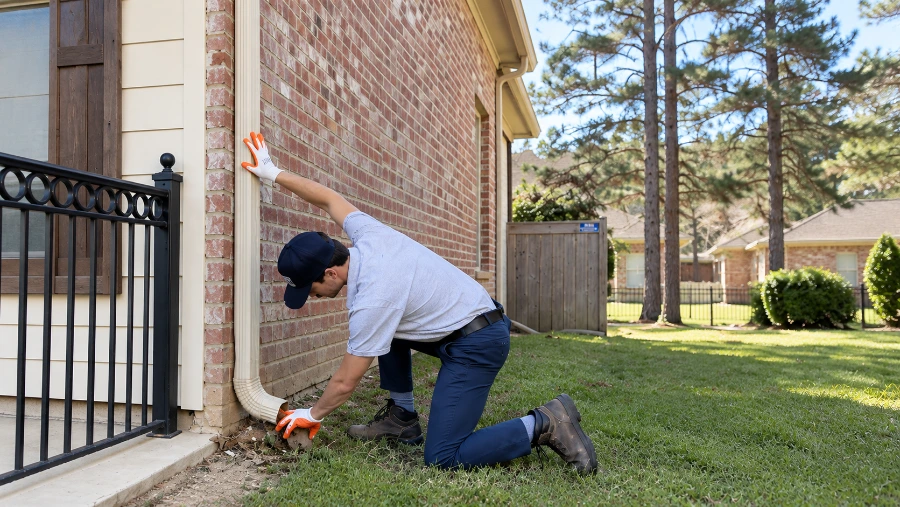
Gutters cleaned but water is still overflowing? The downspout is almost always the reason. We inspect, flush, and clear every downspout — not just the gutter channel.
We check the elbows — where clogs actually form
Not done until water runs clear end to end
The compacted clogs Greenville homes deal with most
Simpsonville, Greer, Taylors, Mauldin & more
Is Your Downspout Clogged? Here’s How to Tell
Most Greenville homeowners assume a gutter overflow problem is a gutter problem. Almost always, it isn’t. If your gutter channel was recently cleaned and water is still pouring over the edge, or pooling against the foundation after every rain, look at the downspout first.
The gutter channel and the downspout are two separate systems with two separate failure points. A gutter cleaning that doesn’t address the downspouts is only half a cleaning.
- Overflow at gutter corners, not along the full edge — corner overflow almost always means the downspout below that corner is blocked
- Water seeping from the seam of the downspout — water escaping from a seam joint means there’s a blockage inside forcing water sideways
- Your downspout is completely silent during heavy rain — a blocked pipe is full of debris and no water is moving through it at all
- Water pooling directly below the downspout discharge point — particularly in Greenville’s clay-heavy soil, where water doesn’t drain away quickly
- Gutters cleaned recently but still overflowing — the gutter channel is clear, but the downspout was never flushed or checked
Why Greenville Downspouts Clog Faster Than Most
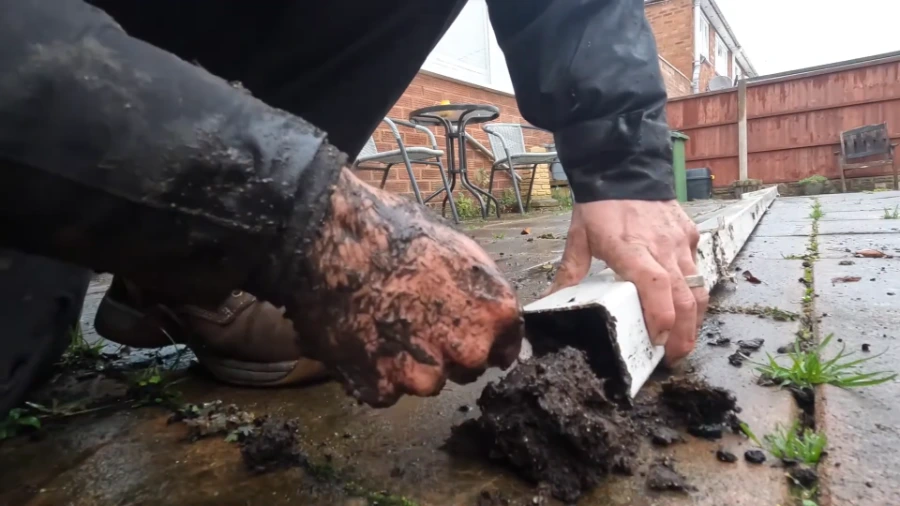
The downspout is an enclosed pipe with two curved elbow bends — one at the top where the gutter meets the pipe, and one where the pipe turns away from the wall. Debris collects at those bends, compacts under its own weight, and eventually creates a plug that water can’t push through. In Greenville, the local tree species make this happen faster and more completely than in most of the country.
Sweetgum Pods — October Through February
Sweetgum trees (Liquidambar styraciflua) are abundant throughout Greenville and Upstate SC. Their seed pods — the hard, spiky balls that cover lawns in fall — are exactly sized to wedge mechanically into a downspout elbow bend. Unlike soft leaves that may flush loose, compacted sweetgum pods resist water pressure and require snaking to clear. This is the most common severe blockage Greenville downspouts develop.
Loblolly Pine Needles — Year-Round
Loblolly pine is one of the most common trees in Upstate SC and unlike most trees, it sheds year-round — not just in fall. Pine needles mat and compress in downspout elbows even when the gutter channel looks clean. Homes with pine coverage nearby need downspout flushing more frequently than the standard twice-yearly cycle.
Willow Oak Leaves — November Through December
Willow oak leaves are narrow and linear — nothing like the broad oak leaves that blow away on their own. They form dense, wet mats at downspout openings in late fall that pack into the elbow inlet and block water flow completely.
Spring Pollen — April Through May
Greenville’s spring pollen season is heavy. When pollen mixes with moisture and existing debris in a downspout elbow, it forms a paste that binds loose material into a more solid plug. A spring flush is needed even on downspouts that appear to be draining.
Shingle Grit and Sediment
Even on homes without heavy tree coverage, fine grit from roof shingles washes into gutters and settles at the bottom of downspout elbows over time. Downspouts can develop partial blockages from shingle sediment alone.
Greenville’s Rainfall and Storm Pattern
Greenville receives more than 50 inches of rain annually — well above the US average of around 38 inches. The Upstate’s orographic thunderstorms are high-volume, short-duration events that send large debris loads into gutters at once. A downspout that drains slowly in a light rain fails completely under a summer storm.
What a Blocked Downspout Does to a Greenville Home
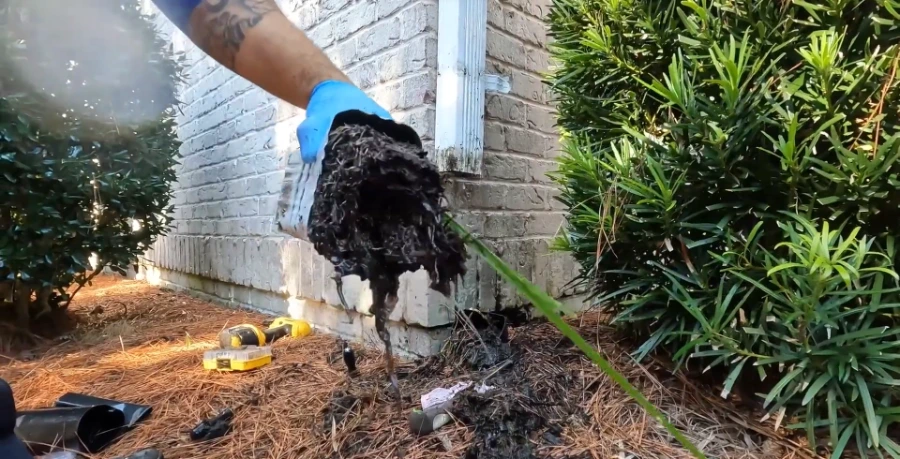
A clogged downspout doesn’t fail loudly. It redirects water — slowly, rain by rain — onto the parts of your home that can least handle it.
Fascia rot and siding stains come first. When water backs up in a blocked downspout, it spills over the gutter edge at that corner and runs down behind the gutter onto the fascia board. Fascia boards absorb moisture and soften within a season or two of repeated saturation — which means the board your gutter hangers are screwed into begins to fail.
Foundation pooling is the more serious consequence — and in Greenville it’s amplified by something most homeowners don’t think about. Greenville sits on Piedmont clay soils — specifically Cecil and Pacolet clay — which are dense and low-permeability. When a clogged downspout discharges water at the foundation base rather than directing it away, that water doesn’t drain into the soil quickly. It pools, saturates the clay, and over time can increase lateral soil pressure against foundation walls. Chronic saturation of clay soils at the foundation base is a recognized risk factor for moisture intrusion and, over many seasons, structural stress.
A blocked downspout is not a cosmetic problem. In a climate with over 50 inches of annual rainfall and clay soils that hold water rather than absorbing it, ignoring an overflow point at the foundation is a slow-motion problem that compounds with each rain event.
How We Clean and Clear Greenville Downspouts
Every blocked downspout is different. We diagnose the type and location of the blockage first, then use the appropriate method — from a simple flush to snaking to disassembly for severe sweetgum pod compaction.
Inspection and Sound Test
We check the downspout outlet and gutter inlet for visible blockage. Then we tap the pipe — a hollow sound means it’s clear, a solid or dull thud means debris is packed inside. We run water from the gutter inlet: if it backs up into the gutter rather than flowing down and out, the downspout is blocked.
Flushing
For loose debris — light leaf accumulation, pine needle buildup, shingle silt — a high-pressure water flush from the top clears the pipe. This works when the debris hasn’t compacted. If the water backs up rather than flowing through, we move to snaking rather than forcing pressure onto a solid plug.
Snaking
A plumbing snake or auger passed through the downspout reaches blockages packed at the elbow bends. Snaking breaks up or grabs compacted debris that flushing can’t dislodge. This is the correct method for sweetgum pods wedged into the top or lower elbow — water pressure alone deflects off a solid plug.
Flow Confirmation
Once the blockage is cleared, we run water again from the gutter inlet all the way through to the discharge point. We verify the entire path is unobstructed and confirm the discharge extension is directing water away from the foundation, not toward it.
What About Underground Downspout Drains?
Many Greenville homes — particularly in newer Simpsonville, Greer, and Taylors subdivisions — have downspout systems that extend underground, running corrugated pipe to a yard drain, street drain, or bio-swale. When these systems block, homeowners often can’t tell whether the problem is in the above-ground downspout or the buried pipe section. Here’s how to read the difference.
- Water doesn’t flow down the downspout at all
- The blockage is above ground — in the gutter outlet, the top elbow, or the vertical pipe section. This is standard downspout cleaning territory. We clear it.
- Water flows into the downspout but backs up at the ground connection
- The above-ground section is clear, but the buried pipe is blocked. Water enters the downspout freely and backs up at the point where it meets the underground system.
- Water flows freely but pools in the yard at the exit point
- The pipe itself is clear, but the discharge end is blocked — by settled soil, root intrusion at the outlet, or debris at the yard drain. The exit needs to be cleared and the grading may need to be checked.
- What we handle vs. what needs specialist equipment
- Above-ground downspout cleaning — the pipe, the elbows, the connection to the buried section — is part of our service. For buried corrugated pipe blocked by root intrusion or soil collapse, that’s a different scope. We’ll tell you clearly what we found and what it needs. We don’t over-promise on underground systems.
Downspout Cleaning Near You in Greenville County
We serve Greenville and the full Upstate SC service area. Most jobs are scheduled within 24–48 hours with no additional travel fees within our standard service area.
How Often Do Downspouts Need Cleaning in Greenville?
Greenville’s tree canopy and rainfall pattern mean downspout maintenance isn’t a once-a-year task for most homes. Here’s the schedule that actually makes sense for Upstate SC.
Spring — April to May
Pollen season creates paste in downspout elbows, binding whatever debris accumulated over winter. A spring flush is recommended even when downspouts appear to be draining — partial blockages that went undetected harden with spring pollen and fail under Greenville’s heavy summer thunderstorms.
Late Fall — November to December
The most critical window. Sweetgum pods have fully dropped and willow oak leaves are coming down simultaneously. This is when elbow blockages form fastest. Schedule a cleaning after the majority of local leaves have fallen but before winter rains test the system.
After Major Storms
Greenville’s summer thunderstorms are high-volume events. A storm that sends a heavy debris load into the gutters at once can block a downspout that was clear the day before. After any storm that put significant debris on your roof, inspect the downspouts regardless of your scheduled cycle.
Homes With Pine Coverage: More Frequent
Loblolly pines shed year-round. Homes with significant pine canopy nearby need downspout flushing more than twice yearly — some need it three or four times. Even with gutter guards installed, the downspout elbows still accumulate pine needle silt and shingle grit. Gutter guards reduce gutter debris, not downspout blockages.
For the full seasonal schedule, see: How Often Should You Clean Your Gutters in Greenville, SC?
Downspout Cleaning Questions — Answered
Real questions Greenville homeowners ask about downspout cleaning, drainage, and what actually causes the overflow.
Also From Greenville Gutter Pros
Downspout cleaning is part of a complete gutter system. Here’s every service we offer for Greenville homes.
Core Service
Gutter Cleaning
Full gutter channel clearing, debris removal, and downspout flushing on every visit. The foundation of a healthy drainage system.
View ServiceThis Service
Downspout Cleaning
Elbow inspection, flushing, and snaking to clear blockages that cause overflow and foundation pooling — the part most cleanings skip.
View ServiceRepair
Gutter Repair
Leaking seams, sagging sections, pulled hangers. We diagnose the root cause and fix it correctly with flow-tested results.
View ServiceNew Systems
Gutter Installation
Custom-measured seamless gutters sized and pitched correctly for your roofline and Greenville’s rainfall volume.
View ServiceProducts
Rain Gutters
Aluminum, copper, and half-round profiles for Greenville homes. Matched to your roofline and installed with correct pitch and hanger spacing.
View ServiceProtection
Gutter Guard Installation
Micro-mesh guards that reduce large debris load into the channel. Less frequent cleaning — not a replacement for it.
View ServiceClogged Downspout in Greenville?
We inspect, flush, and clear every downspout — and we tell you honestly what we find. Serving Greenville, Simpsonville, Greer, Taylors, Mauldin, Easley, Anderson, and Travelers Rest.