
Fall Gutter Cleaning in Greenville, SC
Greenville’s fall leaf season is the busiest and most consequential time of year for gutters. Here’s what Upstate homeowners need to know about timing, debris, and what to inspect before the wet winter period arrives.
Why Fall Is the Most Important Time for Greenville Gutters
Greenville and the Upstate SC region get the bulk of their most consequential gutter debris in a compressed fall window. Oaks, sweetgums, tulip poplars, and maples across established neighborhoods drop the majority of their leaves over roughly six to eight weeks — and that debris lands on rooflines already carrying pine needle accumulation from the rest of the year.
The timing problem is specific to Greenville. In the Upstate, peak fall color typically runs late October into early November, with leaf drop following shortly after. November is typically one of Greenville’s wettest months — meaning the window between “leaves are down” and “gutters need to handle heavy rain” is narrow. Homeowners who wait until December to schedule cleaning often find the first significant winter rain has already run behind siding or pooled at the foundation.
The secondary concern is downspouts. A gutter channel that is half-full of leaves may still pass moderate rain. A downspout sealed by a single sweetgum gumball will fail completely during a storm regardless of how clear the channel looks from the ground. Fall cleaning addresses both.
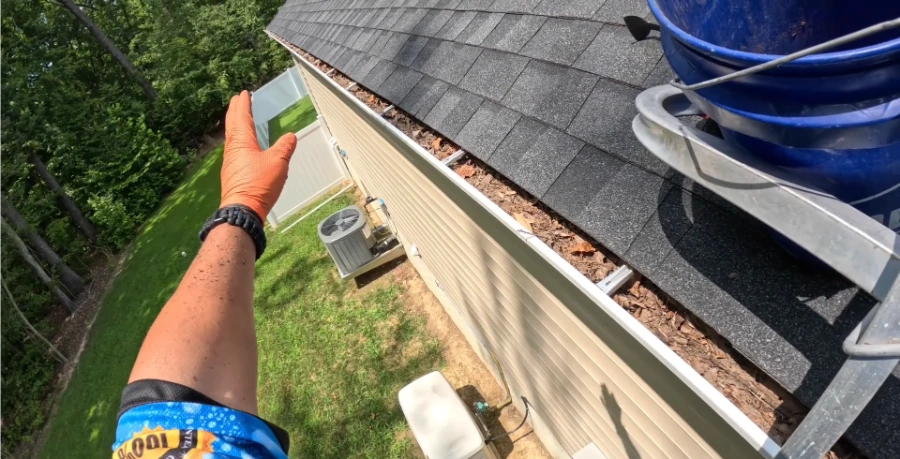
The Fall Timing Window in Greenville
- Peak fall color in the Upstate: late October through early November
- Leaf drop follows peak color — use that as your scheduling signal
- November is typically a high-rainfall month in Greenville
- Best cleaning window: after most leaves are down, before December rains
- Earliest safe window: mid-October for homes with early-shedding species
- Pine needle accumulation continues year-round — compounds fall debris
The Debris Greenville Gutters Face Each Fall
Upstate South Carolina’s mature tree canopy produces several distinct debris types in the fall, each with different effects on gutters and downspouts.
Oak Leaves — Heaviest Volume
Multiple oak species grow throughout Greenville’s established neighborhoods — Southern red oak, white oak, water oak, willow oak. Oak leaves are large, dense, and slow to break down. They pack into the gutter channel and can form a near-solid mat in a single season. Multiple oak species dropping simultaneously in October and November compound the load.
Sweetgum — Downspout Risk
Sweetgum (Liquidambar styraciflua) is native to Piedmont riparian zones and common throughout Greenville County. The star-shaped leaves add to the fall debris load. The harder problem is the seed capsules — spiky gumballs that do not flatten, dissolve, or flush through. A single gumball lodged at the downspout opening seals it completely. This is not visible from the ground.
Pine Needles — Year-Round Base Layer
Loblolly and shortleaf pines shed needles continuously throughout the year, not in a single fall event. By the time fall leaves arrive, a mat of pine needles often already occupies the gutter floor. Needles interlock and do not flush through — they form a dense filter that water cannot pass through even at small accumulation volumes. Fall cleaning must address both the needle mat and the leaf load on top of it.
Tulip Poplar and Maple
Tulip poplars and red maples are common in older Greenville neighborhoods and add to the mid-fall debris peak. Tulip poplar leaves are large; maple seeds (samaras) are lighter and tend to wash into downspouts rather than packing the channel. Both add to the combined fall load that peaks in October and November.
Storm-Driven Acceleration
Greenville’s fall weather includes storms and wind events that can knock down leaves and debris in a matter of hours rather than days. A gutter that was functional on a Monday can be fully blocked by Thursday after a wind-driven rain. The compressed nature of Upstate fall debris means timing the cleaning window carefully matters more here than in slower-shedding climates.
Cecil Clay Foundation Risk
Greenville County sits on Cecil Series clay soils that drain slowly. When gutters overflow and water saturates the ground at the foundation perimeter, the clay holds moisture in place rather than dispersing it. In fall and winter, when rainfall is highest and the ground is already saturated, a clogged gutter system is not just an inconvenience — it directs concentrated water exactly where it should not go.
What Greenville Homeowners Should Inspect Each Fall
A fall gutter inspection covers more than just whether the channel has leaves in it. The following are the specific things worth checking — either yourself from the ground or by scheduling a professional cleaning that includes an inspection as part of the service.
The Gutter Channel
Look for visible debris from the ground and check whether water flows freely after rain or backs up and spills over the front edge. Standing water visible from below the roofline after rain has stopped is a reliable sign of blockage or pitch problems.
Downspouts
Tap each downspout near the bottom during or after rain. A hollow sound means water is flowing; a dull thud means the downspout is backed up. Sweetgum gumballs in particular seal downspouts at the outlet — a clean-looking gutter trough above does not mean a clear downspout below. Check that discharge extends well away from the foundation, not pooling at the base.
Hangers and Pitch
Look for sections of gutter that appear to sag or pull away from the fascia. A sagging section holds standing water year-round and accelerates debris buildup. Hanger fatigue is common in homes with older sectional aluminum systems — many Greenville neighborhoods have houses built in the 1960s through 1990s where original hangers are now decades old.
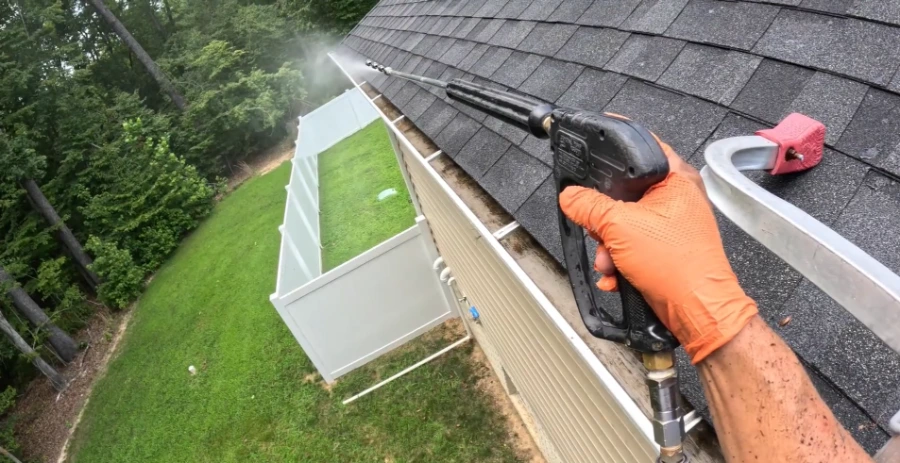
Signs Your Gutters Need Attention This Fall
- Water spilling over the front edge during rain
- Dark staining on siding below the gutter line
- Water pooling at the foundation after rain
- Visible debris or sagging from the ground
- Downspouts that sound dull rather than hollow when tapped
- Gutter sections visibly pulling away from the fascia
- Landscape erosion directly below a downspout
What Happens When Fall Cleaning Is Delayed
Postponing fall gutter cleaning past the leaf-drop window creates a sequence of compounding problems that are harder and more expensive to address later.
Debris Compacts and Retains Moisture
Leaves left in gutters through November and December compact under their own weight and absorb moisture from rain. A compacted debris mat is significantly heavier than loose leaves and takes longer to remove. In older systems, the added weight accelerates hanger fatigue and can pull sections away from the fascia over a single winter.
November and December Rain Has Nowhere to Go
Greenville typically sees elevated rainfall in November and December. A gutter system blocked by fall debris during this period redirects water over the front lip and down the side of the house. Repeated overflow during the wet season saturates the ground at the foundation perimeter — the worst possible outcome on Piedmont clay that holds moisture rather than draining it away.
Standing Water Accelerates Gutter Deterioration
A debris-clogged gutter holds standing water continuously through the wet season. Standing water accelerates seam separation, oxidation at screw points, and rust in steel fasteners. Systems that were serviceable before fall often need repair work the following spring that would not have been necessary with a timely cleaning.
Pest and Mold Issues Through Winter
Moist debris in gutters is a hospitable environment for mold growth and provides nesting material for insects and rodents looking for winter shelter near a structure. Gutters that were not cleaned in fall tend to require more thorough cleaning and sometimes remediation the following spring.
When Professional Fall Gutter Cleaning Makes Sense
DIY gutter cleaning is feasible for single-story homes with straightforward rooflines and easy ladder access. For most Greenville homeowners, however, professional cleaning covers things a ground-level check cannot.
A professional cleaning includes a downspout flush — running water through every downspout from the top to confirm it is clear at the outlet. This is the step most homeowners skip when cleaning themselves, and it is specifically the step that catches sweetgum gumballs sealed at the outlet. A clean-looking channel above a blocked downspout will not announce itself until the gutter is actively overflowing.
Professional cleaning also includes an on-ladder inspection of hanger condition, seam integrity, and gutter pitch. Issues identified during a cleaning visit — a sagging section, a failing seam, a downspout connection that has separated — can be noted and addressed before they become water-damage problems. Our gutter repair service is available when cleaning reveals a problem worth fixing.
Two-story homes, steep pitches, complex rooflines, and significant canopy overhead all increase both the risk and the thoroughness gap between DIY and professional service. For most two-story or heavily canopied properties, the inspection value alone justifies professional cleaning over a self-service approach. To schedule fall cleaning throughout Greenville and Upstate SC — including Taylors, SC — see our gutter cleaning service.

What a Professional Fall Cleaning Includes
- Full debris removal from every gutter channel
- Downspout flush — every outlet confirmed clear
- Hanger and seam inspection from the ladder
- Gutter pitch check — standing-water sections noted
- Before-and-after photos sent same day
- Written summary of any repair issues identified
For pricing information, see our gutter cleaning cost page. For questions about how often to schedule, see our guide on how often to clean gutters in Greenville County.
Fall Gutter Checklist for Greenville Homeowners
Run through this before the November wet period arrives.
- Wait until most leaves are down before scheduling. A cleaning in early October will fill back up before Thanksgiving. Mid-to-late November is the typical sweet spot for Greenville after the oak and sweetgum drop.
- Check downspouts, not just the channel. Tap each downspout near the bottom after rain. Dull sound means blocked. A gutter can look nearly empty and still be backed up because a gumball has sealed the outlet.
- Confirm downspouts discharge well away from the foundation. Greenville clay soil does not drain quickly. Downspout extensions should move water at least several feet from the foundation footing.
- Look for sagging sections from the ground. A visibly sagging gutter holds standing water year-round. If you see a section pulling away from the fascia, that is a hanger problem worth addressing before winter.
- Check for staining on siding below the gutter line. Dark streaking or staining on siding or fascia directly below the gutter is a sign of chronic overflow, not just a one-time event.
- Schedule before December if possible. November is typically wet in Greenville. Having gutters clear before the November-December rainfall period means the system is working when it is most needed.
- Plan for a spring cleaning too. Spring brings pine pollen and oak catkin drop (mid-April through May in the Upstate) — the second peak debris event of the year. Fall and spring together cover the two major Greenville debris events. See our year-round Greenville gutter maintenance calendar for the full seasonal picture.
Fall Gutter Cleaning — Greenville SC Questions Answered
Common questions from Greenville and Upstate SC homeowners about fall gutter maintenance and timing.
Ready to Schedule Fall Gutter Cleaning?
Free estimates for gutter cleaning throughout Greenville and Upstate SC. We send before-and-after photos on every job.