
Greenville, SC Gutter Maintenance Calendar
A year-round guide to when Greenville and Upstate SC gutters need attention — built around the actual debris calendar of the SC Piedmont, not a generic national schedule.
Why a Generic Gutter Calendar Doesn’t Work for Greenville
Most “clean your gutters twice a year” advice is written for the national average — a region with one fall leaf event and a modest spring. Greenville and the Upstate SC Piedmont have a more layered debris calendar that doesn’t fit that template.
The SC Piedmont’s tree mix creates two distinct major debris peaks and a year-round pine needle base load. Fall brings the heaviest single event: oaks, sweetgums, tulip poplars, and maples dropping in a compressed window. Spring brings a separate event of its own — oak catkins and pine pollen in mid-April through May, which produce a different kind of clog than leaf debris does. And in between, loblolly and shortleaf pines shed needles continuously, building a base layer in the gutter trough regardless of season.
Then there is Greenville’s rainfall pattern. Greenville receives significant year-round rainfall, with elevated fall and winter totals following the debris peak — meaning the window between “gutters need service” and “gutters are handling heavy rain” is narrow. This calendar is built around that specific local reality.
Greenville’s Gutter Debris Calendar at a Glance
- Jan–Feb: Pine needles accumulate; sweetgum balls still in downspouts from fall
- Mar–Apr: Pine pollen begins; oak catkins approaching
- Mid-Apr–May: Oak catkin drop — spring cleaning window
- Jun–Sep: Storm season; pine needles building; post-storm checks
- Late Oct–Nov: Peak fall color → leaf drop; primary cleaning window
- Nov–Dec: Elevated rainfall; gutters must be clear before this arrives

Greenville Gutter Maintenance — Month by Month
This calendar is organized around Greenville’s actual debris and rainfall pattern — not a generic schedule. Use it to understand why each window matters and how to plan service accordingly.
Post-Fall Recovery and Winter Drainage
January and February are recovery months for Greenville gutters. If fall cleaning happened on schedule, the system should be clear and functional. The main winter task is monitoring: check for ice-related hanger stress after hard freezes (uncommon but possible in the Upstate), confirm downspouts are still discharging correctly, and watch for any overflow evidence after heavy winter rain events.
Sweetgum gumballs that weren’t caught in the fall cleaning may still be lodged at downspout outlets. If overflow is occurring in January despite a fall cleaning, the downspout is worth checking first. Pine needles continue to accumulate throughout winter, building toward the base load that will be present when spring arrives.
- Check for overflow after any heavy rain event
- Verify downspout discharge is moving water away from the foundation
- Note any sections showing hanger stress after freeze-thaw cycles
- No cleaning typically needed unless fall was skipped
Pine Pollen Arrival and Pre-Catkin Watch
March brings the visible start of Greenville’s spring pollen season — the yellow-green film on every surface. Pine pollen itself is fine and tends to wash through gutters with rain rather than blocking them. But it is a signal that the spring debris event is building.
By late March and early April, loblolly pines are shedding male pollen cones alongside their pollen. Oak trees are budding and will begin shedding catkins — the small, worm-like flower clusters — in mid-April. Early April is the time to plan the spring cleaning rather than schedule it: the catkin drop has not yet peaked, and cleaning too early means the gutters will fill again before May.
- Watch for the start of oak catkin drop (signal to schedule spring cleaning)
- Do not clean yet — wait until the catkin peak has passed
- Check that downspouts from winter are still clear and draining
Oak Catkin Drop — Spring Cleaning Window
Mid-April through May is Greenville’s second major debris event. Oak catkins — the pollen-bearing flower clusters that oaks drop in late spring — fall in volume, mix with pine pollen in the gutter trough, and together form a matted layer that water cannot easily pass through. The catkin mat is different from fall leaf debris: lighter individually but highly adhesive in wet conditions, binding to the gutter surface and to each other.
The spring cleaning window opens once the catkin drop has largely finished — typically late April through May depending on the year and the specific oak species on a given property. Cleaning too early catches only part of the catkin drop. Waiting until early June means a cleared system heading into summer storm season.
For more on how oak catkins affect gutters and when to clean, see our fall gutter cleaning guide for the seasonal overview, or how often to clean gutters in Greenville County for the frequency framework.
- Schedule spring cleaning after the catkin drop peaks (late April–May)
- Full debris removal including pollen-and-catkin mat layer
- Downspout flush — catkin-pollen mat can seal outlet just as leaves can
- System should be clean and clear heading into summer storm season
Storm Season and Pine Needle Accumulation
Summer in the Upstate means intense afternoon thunderstorms capable of delivering significant rainfall in a short window. A gutter system that is mostly clear can still fail during a storm if a partial pine needle mat is blocking the downspout outlet. Post-storm checks are worthwhile after any heavy event — specifically watching for overflow evidence, standing water at the foundation, or water running down siding.
Pine needle accumulation is continuous through summer. Properties with significant loblolly or shortleaf pine canopy directly overhead will see needle buildup between the spring and fall cleanings. For homes with heavy pine cover, a mid-summer check — not necessarily a full cleaning — can identify whether buildup warrants attention before fall leaf drop arrives on top of it.
Hurricane season runs June through November. Tropical systems have historically reached Upstate SC in weakened form, but can still deliver significant rainfall in a short period. Hurricane Helene in September 2024 produced over 11 inches of rainfall in Greenville in a single event — a reminder that having gutters functional before storm season matters more than it might seem in a landlocked Piedmont location.
- Check for overflow or foundation pooling after any heavy storm
- Homes with heavy pine canopy: consider mid-summer inspection
- No full cleaning needed for most homes if spring was completed
- Confirm downspouts are still discharging away from foundation
Fall Leaf Drop — Primary Cleaning Window
Late October through November is the single most important maintenance window of the year for Greenville gutters. In the Upstate, peak fall color typically falls in the late October to early November range, with leaf drop following. The debris load from oaks, sweetgums, tulip poplars, and maples in this window is the heaviest of the year — and it lands on top of pine needle accumulation already in the trough from summer.
The timing problem is specific to Greenville’s climate: November is typically one of the area’s higher-rainfall months, which means the window between “leaves are down” and “gutters need to handle heavy rain” is narrow. The practical fall cleaning window is mid-to-late November — after the oak and sweetgum drop has largely finished but before December rains arrive in volume.
Sweetgum gumballs are the hidden fall risk. The spiky seed capsules do not flush through downspouts — they lodge at the outlet and seal it completely, causing overflow even when the gutter channel above looks mostly clear. Every fall cleaning should include a downspout flush to confirm the outlets are clear, not just channel clearing. When you’re ready to book, our Greenville gutter cleaning service covers all of Upstate SC.
For the complete fall gutter maintenance guide, including what to inspect and what happens when cleaning is delayed, see our fall gutter cleaning guide for Greenville, SC.
- Schedule after the majority of leaves have dropped (mid-to-late November)
- Full debris removal from every channel
- Downspout flush — every outlet confirmed clear
- Hanger and seam inspection from the ladder
- System must be clear before December rains
Post-Cleaning Winter Watch
December is typically one of Greenville’s wetter months, which is precisely why fall cleaning must happen in November rather than December. If the fall cleaning was completed on schedule, December is a monitoring month: check for overflow after heavy rain events, confirm downspout discharge is functional, and note any hanger issues that may have appeared after a heavy leaf load.
If fall cleaning was not completed and gutters are carrying full debris into December, prioritizing the cleaning as early as possible in December — before the wet period intensifies — reduces the risk of overflow damage through the winter.
- Monitor after rain — watch for overflow or foundation pooling
- If fall was skipped, clean in early December before wet period peaks
- Check downspout discharge away from foundation
Dig Deeper Into Each Season
Each seasonal window has its own debris type, timing, and risk profile. These guides go further than the calendar overview above.
Fall Gutter Cleaning Guide
The complete guide to fall timing, debris types, what to inspect, what happens when cleaning is delayed, and when professional service makes sense for Greenville homeowners.
Read the Fall GuideHow Often to Clean Gutters in Greenville
The frequency framework for Greenville County — how tree canopy, roof complexity, and history determine whether your home needs twice-yearly cleaning or more.
Read the Frequency GuideGutters Overflowing in Greenville
If gutters are overflowing now — or continued to overflow after a cleaning — this guide walks through the causes and what they mean for the system.
Read the Overflow GuideGutter Repair in Greenville
When seasonal inspections reveal a hanger problem, failing seam, or pitch issue — what our repair service covers and how it’s diagnosed.
See Repair ServicesGutter Guards in Greenville
Whether guards reduce the seasonal cleaning burden — and how different guard types handle Greenville’s specific debris mix including sweetgum seed capsules and pine needles.
See Guard OptionsGutter Cleaning Cost in Greenville
What professional gutter cleaning costs in Greenville, SC — real local figures, the factors that move price, and how to evaluate an estimate.
See Pricing InformationWhat Determines Your Greenville Home’s Cleaning Schedule
The twice-yearly schedule — fall and spring — is the correct starting point for most Greenville homes. But several property-specific factors push that baseline up or down.
Factors That Increase Cleaning Frequency
- Pine trees directly overhead (year-round needle accumulation)
- Sweetgum trees near the home (gumball downspout risk)
- Multiple large oaks with overlapping canopy
- Two-story home with complex roofline (more valley debris concentration)
- Older sectional gutter system (hanger fatigue accelerates debris buildup)
- History of overflow or foundation moisture
Factors That Allow a Standard Schedule
- Newer seamless gutter system with good pitch and hidden hangers
- Modest canopy — few trees directly over the roofline
- No sweetgum or heavy pine directly overhead
- Single-story with simple roofline and straightforward downspout layout
- Consistent maintenance history with no overflow events
The Two Cleanings That Cover Most Greenville Homes
- Fall (mid-to-late November): After oak and sweetgum drop, before December rains. This is the more critical of the two.
- Spring (late April–May): After oak catkin and pollen drop, heading into summer storm season.
For a detailed frequency framework, see our guide on how often to clean gutters in Greenville County. Prefer a hands-off approach? See how our gutter maintenance plan handles both seasonal visits automatically.
Ready to Get on the Right Schedule?
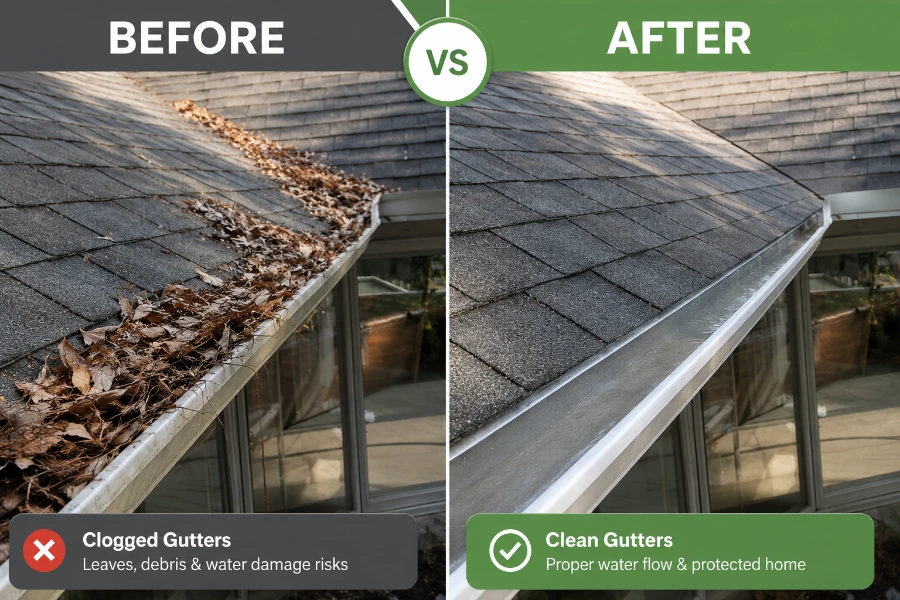
Free estimates for professional gutter cleaning throughout Greenville and Upstate SC, including Taylors, SC. We send before-and-after photos on every job.