
How Often Should You Clean Your Gutters in Greenville, SC?
How Often Should You Clean Your Gutters in Greenville, SC?
The right gutter cleaning frequency depends on your trees, not a one-size-fits-all number. Here's how to determine the correct schedule for your specific property.
Most Greenville homes need their gutters cleaned two to four times per year. But that number is a starting point, not a rule. The trees on and around your property — their species, size, and how close they hang over your roofline — are the primary factor that determines how often your specific gutters actually need attention.
A home with a clear roofline and no overhanging trees can often manage with two cleanings a year. A home surrounded by mature pines or sweet gums may need four or more. This guide walks you through how to determine the right schedule for your property.
The Baseline: What Most Greenville Homes Need
For a Greenville home with moderate tree coverage — a few trees nearby but no heavy canopy directly over the roof — a two-cleaning schedule is the practical baseline:
- Late November or early December — after the bulk of deciduous leaves have fallen
- Late spring — after tree pollen, seed pods, and spring debris have finished dropping
These two windows address the two heaviest natural debris events in the Upstate South Carolina calendar. If your home fits this profile and you stay on that schedule, you will avoid the most common gutter problems.
Why Greenville’s Trees Change the Calculation
Greenville sits in a region with high tree density and a long growing season. The specific trees on your property affect not just how much debris lands in your gutters but when that debris falls — which determines when cleanings actually need to happen.
A few patterns worth knowing:
- Pine trees shed needles year-round. They also produce heavy pollen in late winter and early spring. Homes with large pines overhead typically need three to four cleanings annually, including a late-winter visit before spring rains arrive.
- Oak trees are prolific producers of small catkins and tannin-rich leaves in spring, and they shed acorns and leaves in fall. Oaks generate two heavy debris seasons per year.
- Sweet gum trees drop spiky seed balls through fall and winter — these are notoriously difficult to flush from downspouts and tend to create blockages rather than simply accumulating in the gutter channel.
- Deciduous trees (maples, dogwoods, tulip poplars) follow a more predictable fall-drop pattern, making one late-fall and one late-spring cleaning generally sufficient if these are the dominant species.
If your yard has a mix of pine and deciduous trees, you are likely dealing with debris from multiple seasons simultaneously and should plan for at least three cleanings. For a detailed look at how tree canopy affects your gutters, see our guide on gutters overflowing in Greenville, SC.

How to Determine the Right Schedule for Your Home
Use this decision framework to identify the appropriate cleaning frequency for your specific property:
| Property Situation | Recommended Annual Cleanings |
|---|---|
| No overhanging trees, minimal surrounding canopy | 2 (spring + fall) |
| Moderate deciduous tree coverage nearby | 2–3 |
| Mature oaks or mixed deciduous canopy overhead | 3 |
| Significant pine coverage, or pines + deciduous mix | 3–4 |
| Heavy canopy directly over roofline (any species) | 4+, inspect after storms |
The most reliable way to calibrate your schedule is to inspect your gutters at the end of each season and note what you find. If gutters are still mostly clear six months after a cleaning, your two-per-year schedule is working. If you consistently find them heavily loaded, add a cleaning cycle.
When to Schedule Each Cleaning in Greenville
Timing matters. Cleaning too early in a debris season means a second round of material accumulates before the next rain. The following windows work well for Upstate South Carolina:
- Late November to mid-December — after the majority of deciduous trees have dropped their leaves. This is the most important cleaning of the year for most Greenville homes.
- Late April to May — after spring pollen and seed-pod season winds down. Oak catkins and pine pollen can accumulate quickly and form a paste inside gutters when wet.
- Mid-to-late August (if doing 3+ cleanings) — a mid-year check before late-summer thunderstorm season. Debris that has accumulated through summer can cause overflow during the heavier rainfall Greenville receives in late summer and early fall.
- Late February or early March (if doing 4 cleanings) — particularly relevant for homes with heavy pine coverage. This clears winter needle accumulation before spring rains and captures early pollen before it binds inside the channel.
Signs Your Gutters Need Cleaning Sooner Than Scheduled
Regardless of your planned schedule, these signs indicate your gutters need attention now rather than later:
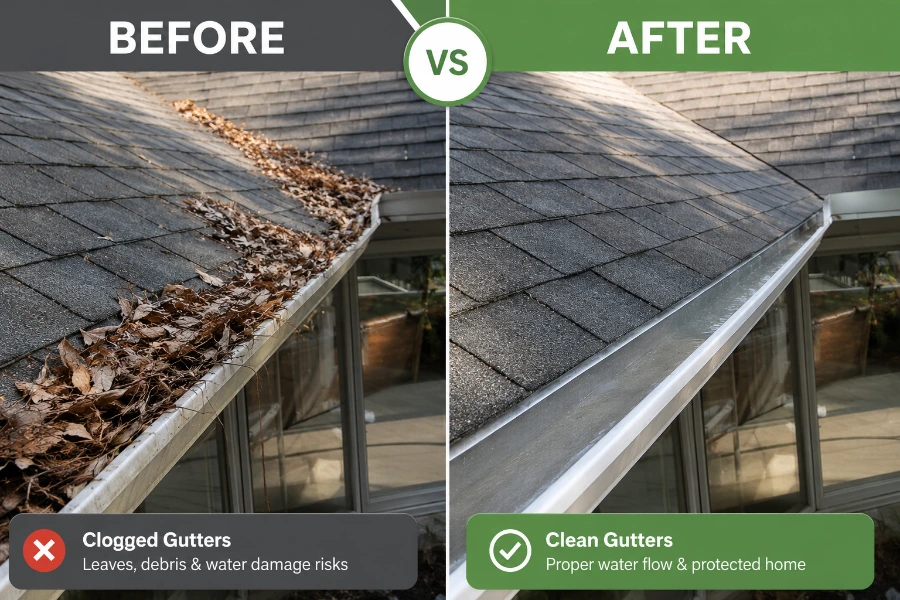
- Water spilling over the gutter edge during rain — the clearest sign of a blockage or heavy debris load
- Water staining on fascia boards or siding — indicates gutters are overflowing somewhere along the run
- Plants or moss growing from the gutter channel — soil and organic material have been sitting long enough for vegetation to take hold
- No water exiting the downspout during rain — the downspout is blocked, often by compacted debris or a sweet gum ball lodged in the elbow
- Sagging gutter sections — the weight of wet debris is pulling the gutter away from the fascia
If you notice any of these after a major storm, do not wait for your next scheduled cleaning. Overflowing gutters can cause fascia damage, foundation saturation, and landscape erosion that becomes progressively more expensive to address.
Do Gutter Guards Change How Often You Need to Clean?
Gutter guards reduce cleaning frequency for most homes — but they do not eliminate it. The key variable is, again, tree type.
A quality micro-mesh guard installed on a home with moderate deciduous coverage can reduce cleaning from two to three times per year down to once. But homes with heavy pine canopy still need annual inspection and periodic flushing even with guards installed, because pine needles, pollen, and small debris can accumulate on top of the mesh and impede water flow without actually entering the gutter.
Sweet gum balls present a different challenge: they can wedge against a guard’s inlet and divert water over the edge even when the gutter channel beneath is clear.
If you are considering guards, read our detailed breakdown of gutter guard options for Greenville properties — including which guard types perform best against the specific debris profiles common in the Upstate region.
If your gutters have existing damage — sagging sections, separated joints, or cracks — those need to be addressed before guards are installed. See our gutter repair page for what that work typically involves.
Frequently Asked Questions
How often should gutters be cleaned in South Carolina?
For most South Carolina homes, twice a year is the minimum — once after fall leaf drop and once after spring pollen season. Homes with significant pine or mixed-canopy coverage typically need three to four cleanings annually. The right number depends on the trees on your specific property, not a universal rule.
Is twice a year enough for gutter cleaning?
It depends on your tree situation. For homes with limited canopy overhead and mostly deciduous trees, two annual cleanings are usually sufficient. If you have pines, oaks, or sweet gums overhanging your roof, two cleanings may not be enough — debris accumulates faster and from more seasons than a twice-yearly schedule can address.
What time of year is best to clean gutters in Greenville, SC?
The most important cleaning window is late November to mid-December — after the majority of deciduous trees have dropped. The second most important is late April to May, after spring pollen and seed pods finish falling. If you do a third cleaning, late August works well to clear summer accumulation before fall storm season.
Can I wait longer between cleanings if I have gutter guards?
Often yes, but it depends on your guard type and tree coverage. Quality micro-mesh guards on homes with moderate deciduous trees can stretch the interval to once a year. Homes with pines, oaks, or sweet gums still need periodic inspection even with guards installed, as debris can accumulate on top of the mesh or block inlets without entering the gutter itself.
How do I know if my gutters are clogged between scheduled cleanings?
Watch for water spilling over the front edge during rain, water stains on fascia or siding, and no water exiting downspouts during a rain event. These are the most reliable signs of a blockage. After any significant storm, a quick visual inspection from the ground can catch problems before they lead to more serious damage.
Ready to Set the Right Schedule?
We are Greenville Gutter Pros — a locally owned crew serving Greenville and Upstate South Carolina. We clean thoroughly, flush every downspout, and document the work with photos. Get an honest assessment and a clear estimate.